How DevOps Consulting Services Improve Healthcare Performance


Introduction
Healthcare providers rely on Healthcare Applications such as Electronic Health Records (EHR), telemedicine platforms, patient portals, healthcare mobile applications, and Hospital Management Systems to support patient care and daily operations. Clinicians need quick access to accurate information, while patients expect reliable digital healthcare services.
Poor application performance can disrupt clinical workflows, delay care delivery, and create compliance challenges for Healthcare IT teams. Slow systems, outages, and deployment issues can affect both operational efficiency and user experience.
DevOps Consulting Services help healthcare organizations improve reliability, security, and application performance. Through automation, monitoring, and continuous delivery, DevOps in Healthcare supports stable systems and faster software updates. In this blog post, we examine how DevOps practices help healthcare organizations improve application performance while supporting patient care objectives.
Why Healthcare Applications Face Performance Challenges in Modern Healthcare IT

Despite investments in digital tools, many healthcare organizations continue to face performance issues with their Healthcare Applications. Several factors contribute to these challenges, often limiting the ability of systems to support growing operational and clinical demands.
Legacy Infrastructure Slows Performance
Many hospitals still rely on older systems and monolithic applications that were not built for frequent updates. Outdated integrations between platforms can create bottlenecks, slowing data exchange, and making system improvements more difficult for Healthcare IT teams.
Growing Patient Data and System Complexity
Modern healthcare environments process vast amounts of data, including electronic health records, medical imaging files, and information from IoT medical devices. At the same time, connected healthcare ecosystems require data sharing across providers, insurers, pharmacies, and patients, increasing system complexity.
Compliance and Security Requirements
Healthcare organizations must comply with regulations such as HIPAA and data privacy requirements. Security reviews and compliance checks are necessary before software releases, and manual processes can delay updates and maintenance activities for critical Healthcare Software.
Downtime Directly Impacts Patient Care
Application downtime can disrupt access to patient records, delay diagnoses, interrupt telemedicine appointments, and affect response times during emergencies.
Because of these risks, healthcare organizations need a modern software delivery approach. DevOps in Healthcare and Healthcare DevOps practices help improve reliability, reduce deployment delays, and support consistent application performance.
What Are DevOps Consulting Services?
DevOps Consulting Services help organizations improve how software is built, tested, deployed, and maintained. DevOps brings development and operations teams together to improve collaboration, automate repetitive tasks, and support faster software delivery with fewer disruptions.
DevOps consultants assess an organization's existing processes, identify gaps, and recommend tools and practices that fit its infrastructure and business requirements. In healthcare, this approach must account for compliance obligations, system reliability, and complex application environments. As a result, DevOps for Healthcare requires a healthcare-specific implementation rather than a standard framework.
Core Components of DevOps Consulting Services
CI/CD pipelines automate software build, testing, and deployment processes.
Infrastructure as Code manages infrastructure through version-controlled files, improving consistency and traceability.
Automated testing helps identify issues before software reaches production.
Monitoring and logging provide visibility into application performance and system health.
Cloud infrastructure supports scalability and resource optimization for healthcare applications.
DevSecOps integrates security and compliance checks throughout the software delivery process.
How DevOps Consulting Services Improve Healthcare Application Performance
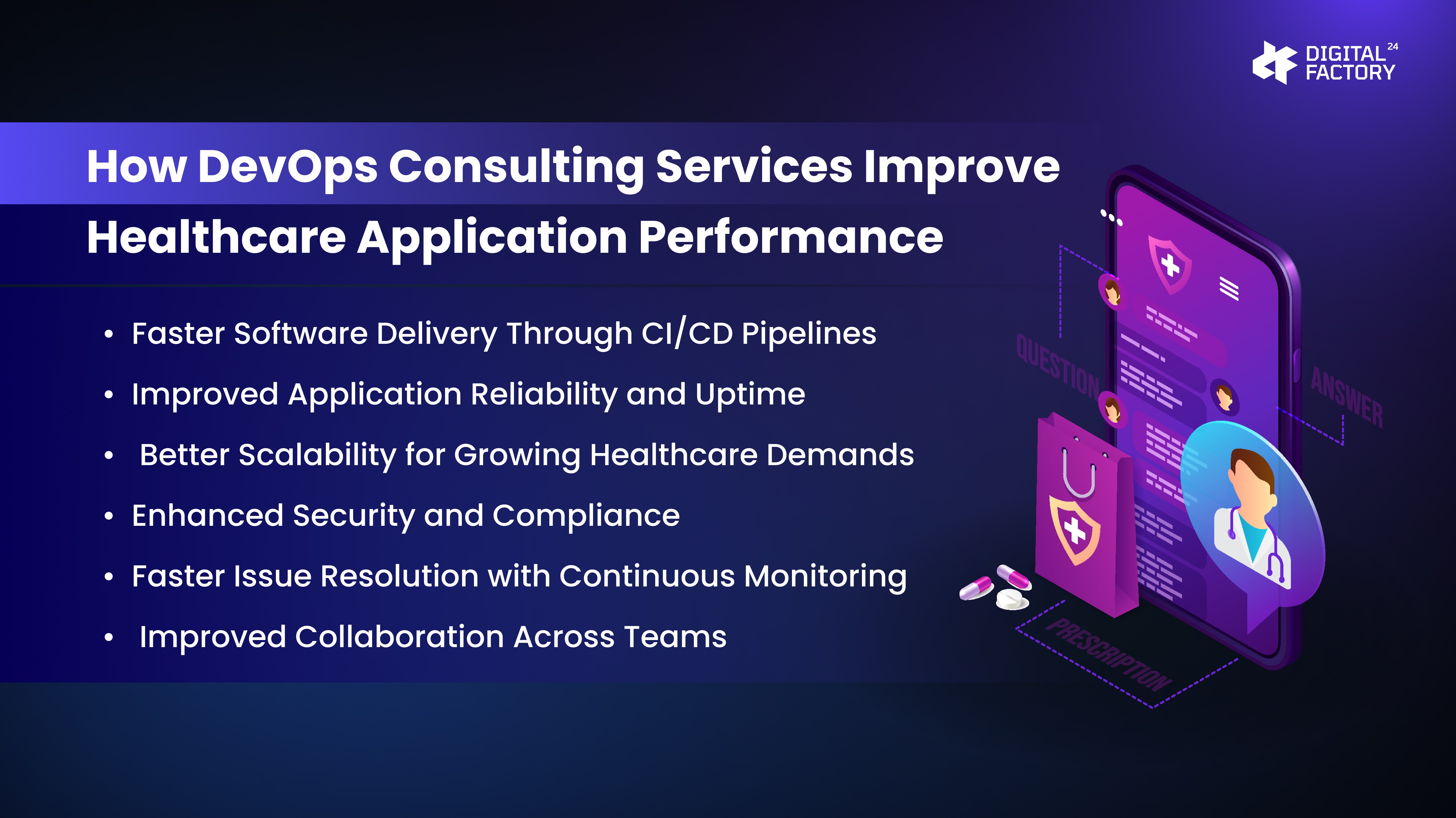
Faster Software Delivery Through CI/CD Pipelines
DevOps Consulting Services help healthcare organizations automate software delivery through CI/CD pipelines. Key benefits include:
Automated build, testing, and deployment processes
Reduced manual effort and deployment errors
Faster bug fixes and software updates
More frequent feature releases
Improved response to clinical and operational requirements
This helps Healthcare DevOps teams deliver changes more quickly while maintaining software quality.
Improved Application Reliability and Uptime
Application availability is critical for healthcare providers. Through continuous monitoring, automated alerts, and incident detection, teams can identify issues before they affect users.
Automated recovery mechanisms, such as service restarts and traffic redirection, improve uptime and reduce downtime. As a result, DevOps in Healthcare supports more reliable systems and fewer disruptions to clinical workflows.
Better Scalability for Growing Healthcare Demands
Healthcare application usage often changes based on patient demand, seasonal trends, and telemedicine adoption. DevOps for Healthcare supports scalability through:
Cloud-native application architectures
Automatic resource scaling during traffic spikes
Improved support for telemedicine growth
Better handling of peak patient loads
Efficient resource utilization
Enhanced Security and Compliance
Security and regulatory compliance are essential for healthcare. DevSecOps strengthens software delivery through:
Automated security testing
Vulnerability scanning
Compliance validation checks
Secure deployment workflows
Automated audit trails for HIPAA reporting
These practices help organizations identify and address security risks before software reaches production.
Faster Issue Resolution with Continuous Monitoring
Continuous Monitoring gives teams real-time visibility into application health. Key capabilities include:
Log analytics for troubleshooting
Performance metrics tracking
Automated alerts for critical issues
Faster root-cause analysis
Ongoing performance optimization
This allows DevOps Consulting Services teams to resolve problems more quickly and improve the performance of Healthcare Applications.
Improved Collaboration Across Teams
Software delivery in healthcare involves developers, operations teams, QA specialists, security professionals, and clinical stakeholders. DevOps Consulting Services promote collaboration through shared processes, common tools, and faster feedback cycles.
This approach reduces miscommunication, accelerates releases, and helps Healthcare DevOps teams deliver software that better supports patient care and operational goals.
Business Benefits of DevOps Consulting Services for Healthcare Organizations
Operational Benefits
DevOps Consulting Services help healthcare organizations improve efficiency and reduce operational overhead. Key operational benefits include:
Reduced operational costs through automation
Faster software releases and shorter time-to-market
Lower deployment failure rates
Higher system availability
Improved productivity for IT and operations teams
Patient-Centered Benefits
The benefits of DevOps in Healthcare are also reflected in the patient experience. Organizations can achieve:
More reliable telemedicine services
Faster and more responsive patient portals
Improved performance of healthcare applications
Fewer disruptions that affect patient access to care
Long-Term Business Growth
Healthcare DevOps supports sustainable growth by providing a more adaptable software delivery model. Long-term advantages include:
Faster adoption of new digital health initiatives
Easier regulatory compliance management
Better return on investment (ROI)
Greater capacity for innovation and service expansion
Best Practices for Successful DevOps Adoption in Healthcare
Build a DevOps Culture
Successful DevOps for Healthcare adoption starts with collaboration. Development, operations, security teams, and healthcare stakeholders should work toward shared goals, improving communication, and reducing delays during software delivery.
Automate Wherever Possible
Automation helps reduce manual effort and improve consistency. Healthcare organizations should automate:
Software testing
Application deployment
Infrastructure provisioning
Monitoring and alerting
This approach reduces errors and supports faster, more reliable releases.
Prioritize Security from the Start
Security should be integrated into every stage of the software delivery process. DevOps Consulting Services often recommend adopting DevSecOps practices such as:
Automated compliance checks
Vulnerability scanning
Audit logging
Security testing
Building security into the pipeline helps organizations meet regulatory requirements more efficiently.
Use Cloud-Native and Scalable Infrastructure
Modern Healthcare DevOps environments benefit from cloud-native technologies. Containers and Kubernetes support application portability, scalability, and efficient deployment management. Cloud platforms provide flexibility, resource scalability, and disaster recovery capabilities.
Continuously Monitor and Optimize Performance
Healthcare applications must be monitored regularly to maintain consistent performance. Teams should track key metrics, use automated alerts, and implement Application Performance Monitoring (APM) tools. Continuous monitoring helps identify performance issues early and supports data-driven optimization decisions.
Why Choose Digital Factory 24 for DevOps Consulting Services
Digital Factory 24 provides DevOps Consulting Services for healthcare organizations. With experience in DevOps in Healthcare, the focus is on improving application performance, reliability, security, and compliance.
Key capabilities include:
Customized DevOps strategies aligned with healthcare requirements
CI/CD pipeline implementation for faster and more reliable software releases
Cloud migration support for modern application environments
Infrastructure automation using Infrastructure as Code (IaC)
Security-first practices with integrated compliance controls
Performance optimization through monitoring and automation
Scalable cloud architectures designed to support growing workloads
End-to-end consulting, from planning and implementation to ongoing support
Conclusion
Modern healthcare applications must deliver reliability, security, scalability, and consistent performance to support both patients and healthcare professionals. DevOps Consulting Services help healthcare organizations achieve these goals by combining automation, continuous delivery, monitoring, and compliance-focused practices.
Successful DevOps in Healthcare relies on more than technology alone. Automation, cross-functional collaboration, and continuous improvement all play a role in maintaining high-performing and secure applications. By adopting Healthcare DevOps practices, organizations can reduce operational challenges while improving software quality and availability.
Digital Factory 24 helps healthcare organizations implement DevOps for Healthcare strategies that support reliable, secure, and high-performing applications. Organizations can also strengthen their digital capabilities through our DevOps Engineering, Cloud Infrastructure, and Digital Product Engineering services.


