Cloud Migration Services for Healthcare: Secure & Scalable Transformation

Introduction
Healthcare is a data intensive industry where every patient visits, lab result, prescription, and billing record generates critical information. This data must be stored securely, accessed quickly, and shared accurately across teams. For many years, healthcare organizations relied on on-premises infrastructure that was costly to maintain, difficult to scale, and increasingly vulnerable to security risks.
Today, many organizations are adopting Cloud Migration Services to modernize their data management and IT systems. The shift supports stronger security controls, improved operational efficiency, and greater flexibility as healthcare needs evolve. However, cloud migration in healthcare requires careful planning due to strict regulatory requirements and the sensitive nature of patient data. A well executed migration strategy helps organizations reduce risk while building a scalable and compliant foundation for the future.
This article outlines cloud migration services in a healthcare context, covering benefits, strategies, processes, challenges, and best practices. It provides practical guidance to help healthcare organizations plan and carry out a secure cloud migration.
What Are Cloud Migration Services in Healthcare?
Cloud migration services in healthcare involve moving electronic health records, clinical applications, billing systems, imaging data, and other healthcare IT systems from on- premises infrastructure to secure cloud platforms. These services include planning, execution, testing, and compliance validation to support regulatory requirements while maintaining system availability and data security throughout the transition.
Cloud consulting services also address the unique operational needs of healthcare environments. They focus on protecting protected health information, integrating with existing clinical systems, and maintaining uptime for applications that support patient care. Healthcare focused cloud migration requires specialized expertise to meet regulatory obligations while supporting reliable and efficient daily operations.
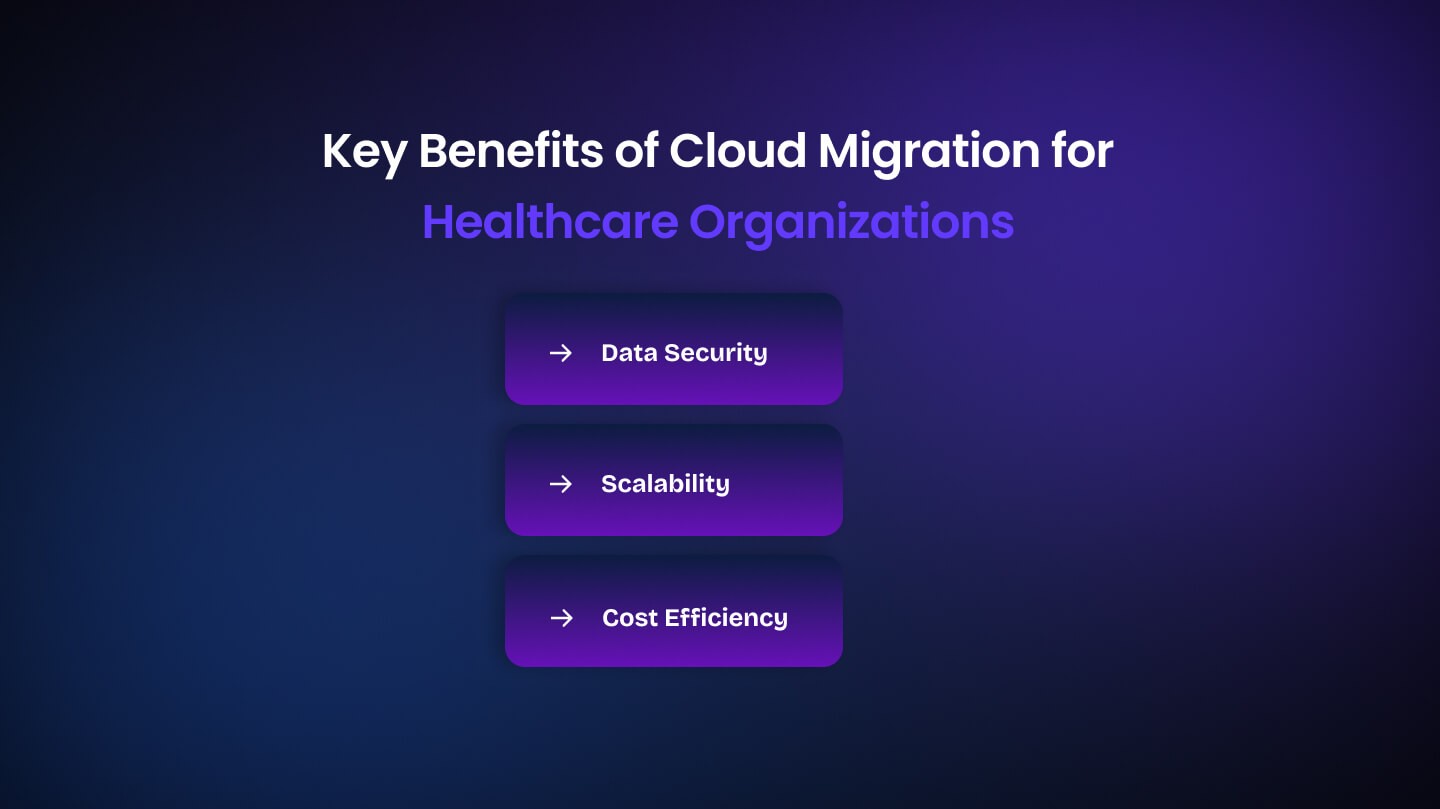
Key Benefits of Cloud Migration for Healthcare Organizations
Data Security
Data security is a primary concern for healthcare organizations moving to the cloud. Traditional on-premises systems often lack the layered protections available in modern cloud platforms. Leading providers such as AWS, Microsoft Azure, and Google Cloud offer encryption, threat detection, access controls, and regular security updates that strengthen overall protection.
Cloud platforms allow organizations to control user access, maintain detailed audit logs, and identify unusual activity early. When configured correctly, cloud environments can provide stronger data protection than most organizations can achieve with local infrastructure.
Scalability
Healthcare demand often changes due to seasonal illness, service expansion, or organizational growth. Scaling on premises infrastructure requires new hardware, long procurement cycles, and high upfront costs. Cloud migration allows organizations to increase or reduce computing and storage resources as needed.
This flexibility supports growth initiatives such as telehealth services, remote patient monitoring, and data intensive clinical applications. Organizations only use and pay for the resources required at any given time.
Cost Efficiency
On premises infrastructure involves fixed costs for hardware, software licenses, maintenance, facilities, and IT staffing. These costs remain even when systems are underutilized. Cloud environments shift expenses to a usage based model, allowing organizations to pay only for the resources they consume.
Cloud migration also reduces the operational burden on IT teams. With support from a cloud migration company, less time is spent on routine maintenance, allowing teams to focus on strategic initiatives, while lowering capital expenses by avoiding frequent hardware replacements.
Types of Cloud Migration Strategies
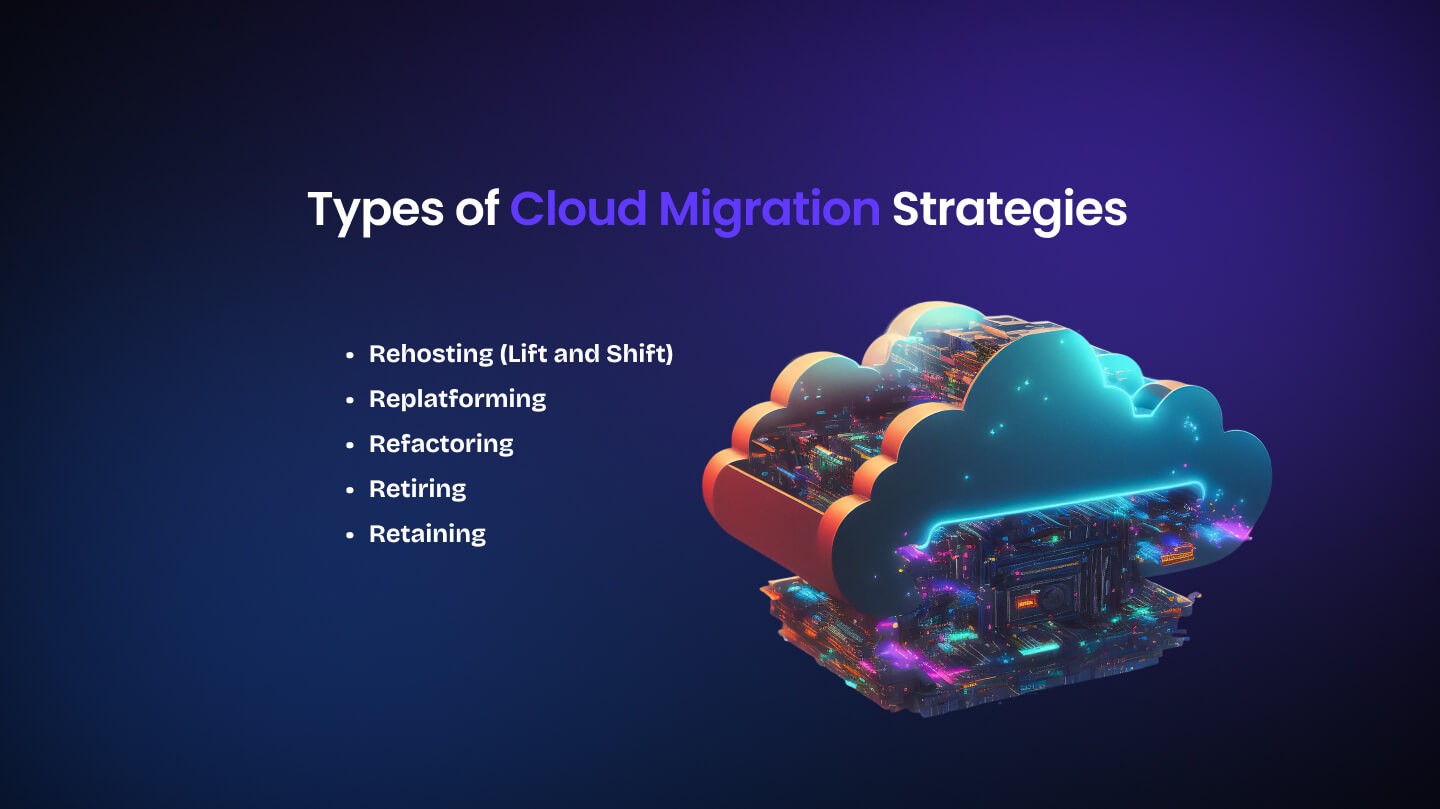
Not every healthcare system is migrated in the same way. The appropriate strategy depends on how the application is built, how critical it is to operations, and how much change is required for it to function effectively in a cloud environment. Common cloud migration strategies in healthcare include the following.
Rehosting (Lift and Shift)
Rehosting involves moving an application to the cloud with minimal or no changes. The application operates in the cloud the same way it did on premises. This approach is fast and suitable for systems that are stable but not yet ready for modernization.
Replatforming
Replatforming includes minor modifications to improve performance in the cloud. Examples include using managed database services or optimizing configurations without altering the core application. This strategy balances migration speed with moderate cloud optimization.
Refactoring
Refactoring involves redesigning the application to operate as a cloud native system. It requires more time and investment but provides improved scalability, performance, and long term cost efficiency. This approach is often used for mission critical systems.
Retiring
Some applications are decommissioned during migration because they are outdated or no longer needed. Retiring unused systems reduces complexity, cost, and security risk. This step helps streamline the overall IT environment.
Retaining
Certain systems may remain on premises due to technical limitations, regulatory concerns, or business requirements. Retaining applications is common in hybrid cloud models. These systems can be revisited for migration at a later stage.
A qualified cloud consulting services team evaluates each application individually and recommends the most suitable migration strategy. This approach avoids unnecessary risk and supports better outcomes.
Step-by-Step Cloud Migration Process
Step 1: Assessment and Inventory
This step involves reviewing the existing IT environment and identifying all systems that handle patient data. Each system is documented and evaluated based on data sensitivity, uptime needs, integrations, and cloud readiness. This assessment creates a clear migration baseline.
Step 2: Compliance and Risk Planning
Regulatory requirements are identified early to avoid compliance gaps later. Teams determine which data is protected under HIPAA and define controls needed for each system. Cloud provider compliance credentials and Business Associate Agreement requirements are also reviewed.
Step 3: Choosing the Right Cloud Environment
Organizations decide whether a public, private, or hybrid cloud model best fits their needs. The choice depends on data sensitivity, compliance requirements, budget, and operational goals. This step defines where each workload will be hosted.
Step 4: Migration Planning
A detailed migration roadmap is created based on system priority and dependencies. Less critical systems are usually migrated first to reduce risk. Rollback procedures are documented to handle unexpected issues.
Step 5: Data Preparation
Data is cleaned, validated, and standardized before migration begins. Duplicate records and outdated formats are corrected to prevent errors. Data fields are mapped to match the target cloud systems.
Step 6: Migration Execution
Applications and data are migrated in controlled phases according to the plan. Encryption and access controls are applied throughout the process. High availability systems use synchronization techniques to keep data current.
Step 7: Testing and Validation
All migrated systems are tested for data accuracy, performance, and integration functionality. Clinical workflows are validated with real users. Issues are resolved before moving to full production use.
Step 8: Training and Go-Live
Staff receive training on updated systems and workflows. The final transition is scheduled during low usage periods to reduce disruption. Support teams remain available during initial live operations.
Step 9: Post-Migration Monitoring
Continuous monitoring is established after the go-live phase to track security, access, and system performance. Compliance checks and risk assessments are performed regularly. This step supports long term stability and regulatory adherence.
Challenges in Healthcare Cloud Migration
Compliance and Regulatory Complexity
Healthcare organizations must comply with HIPAA and HITECH, along with additional frameworks such as HITRUST CSF, SOC 2 Type II, or FedRAMP depending on their operations. Compliance in the cloud requires intentional design across data storage, access controls, and audit logging.
State level regulations such as the California Consumer Privacy Act further increase complexity, especially when healthcare data is stored or replicated across multiple geographic regions.
Data Privacy
Patient data is highly sensitive and frequently targeted by cyber threats, making privacy a major concern during cloud migration. Data must be encrypted during transfer, access limited to authorized users, and all activity involving protected health information logged.
The shared responsibility model means cloud providers secure the infrastructure, while healthcare organizations remain responsible for application and data security, making clarity around responsibilities essential.
Legacy System Integration
Many healthcare organizations rely on legacy systems that were not built for cloud environments supported by cloud consulting services. These systems often use outdated data formats, lack of documentation, or tightly integrated into clinical workflows.
Migrating or connecting them requires detailed planning and technical effort, especially when rebuilding interfaces such as HL7v2 connections and FHIR APIs, which can be more complex than migrating the applications themselves.
Downtime Concerns
System downtime in healthcare can directly impact patient care and clinical decision making. Cloud migrations must be carefully planned to minimize disruptions through phased execution, extensive testing, and well-defined rollback strategies. Maintaining continuous system availability during migration is critical for patient safety and operational stability.
Best Practices for Secure Cloud Migration
Sign Business Associate Agreements before migration. A BAA clearly defines the cloud provider’s responsibility for protecting protected health information and is mandatory under HIPAA.
Classify data before migration. Identifying sensitive and regulated data helps apply appropriate security controls and compliance measures.
Use encryption for data in transit and at rest. Encryption protects patient data from unauthorized access during transfer and storage.
Apply role-based access controls. Users should only access the data required for their role. Multi-factor authentication adds an additional security layer.
Test systems before and after migration. Pre-migration testing identifies data and integration issues. Post migration testing confirms system performance and data accuracy.
Adopt a phased migration approach. Migrating workloads in stages reduces risk and allows validation at each step.
Monitor continuously after going live. Ongoing security assessments and compliance reviews help maintain a secure and compliant cloud environment.
Work with a healthcare experienced cloud migration partner. Specialized knowledge of healthcare regulations and clinical systems significantly reduces migration risk.
Conclusion
Moving to the cloud is a key step for healthcare organizations looking to modernize operations and protect patient data. It also helps create a foundation for long term growth. However, cloud migration in healthcare is not a standard IT project. It requires strong knowledge of regulations and careful handling of sensitive patient information.
Cloud migration services provide the structure and expertise needed for a safe transition. With the right cloud consulting partner, healthcare organizations can move away from costly on-premises systems. They can adopt a more secure, flexible, and scalable cloud environment.
At Digital Factory 24, we combine deep technical expertise and healthcare-specific knowledge to deliver secure cloud migration, Drupal development, and digital transformation solutions. From initial assessment to go-live and ongoing support, we help organizations navigate every stage of their cloud journey with confidence.
FAQs