SEO vs AEO vs GEO: What Is the Difference?


Introduction
The last few years have marked a significant evolution in the way we search online, moving away from the systems of the past couple of decades. There has been a rapid change from simple keyword matching to a web of complex search systems. A brand can no longer afford to ignore the changes in the market if they are to effectively invest in seo marketing.
In the traditional search universe, users are sent to a list of ranked links from which they must choose in order to find the information they are looking for. In contrast, AI-powered systems provide answers, summaries, and conversational responses without the need for a click. For this reason, companies must have multiple optimization strategies. If a company ignores SEO and only relies on AEO, GEO, and their derivatives, they are essentially going to have very little online presence. The best seo company will rely on context and authority, instead of focusing on ranks alone. This will ensure that their presence encompasses all the places where users search.
What Is SEO and Why Does It Still Matter?
Search Engine Optimization refers to the strategies and practices employed to improve the visibility of a web page on traditional search engines like Google or Bing. It remains essential to improve digital web visibility, and any professional search engine optimization services will tell you that the fundamentals of SEO have not changed and will still drive the bulk of organic searches.
Core Features of SEO
Keyword Research - A method of discovering what your potential customers are searching for.
On-Page SEO - The procedure of perfecting the headers, content, and Titles, meta descriptions.
Technical SEO - Making improvements to indexing, crawlability, and speed of a website.
Link Building - Creating authority by gaining backlinks.
Search Intent - Determining what users are searching for and providing the answers they are looking for.
Organic Traffic - The result of a site's long-term and unpaid SEO efforts.
Key Advantages of SEO
Search Engine Optimization improves a site’s search visibility over time, helps build brand reliability from consistent performance in rankings, and brings paying customers to a website (the customers are high intent). The high return on investment (ROI) growth that can be attributed to a sustained and consistent performance from a website, unlike paid media, gives SEO an advantage over other growth tactics.
What is Answer Engine Optimization (AEO)
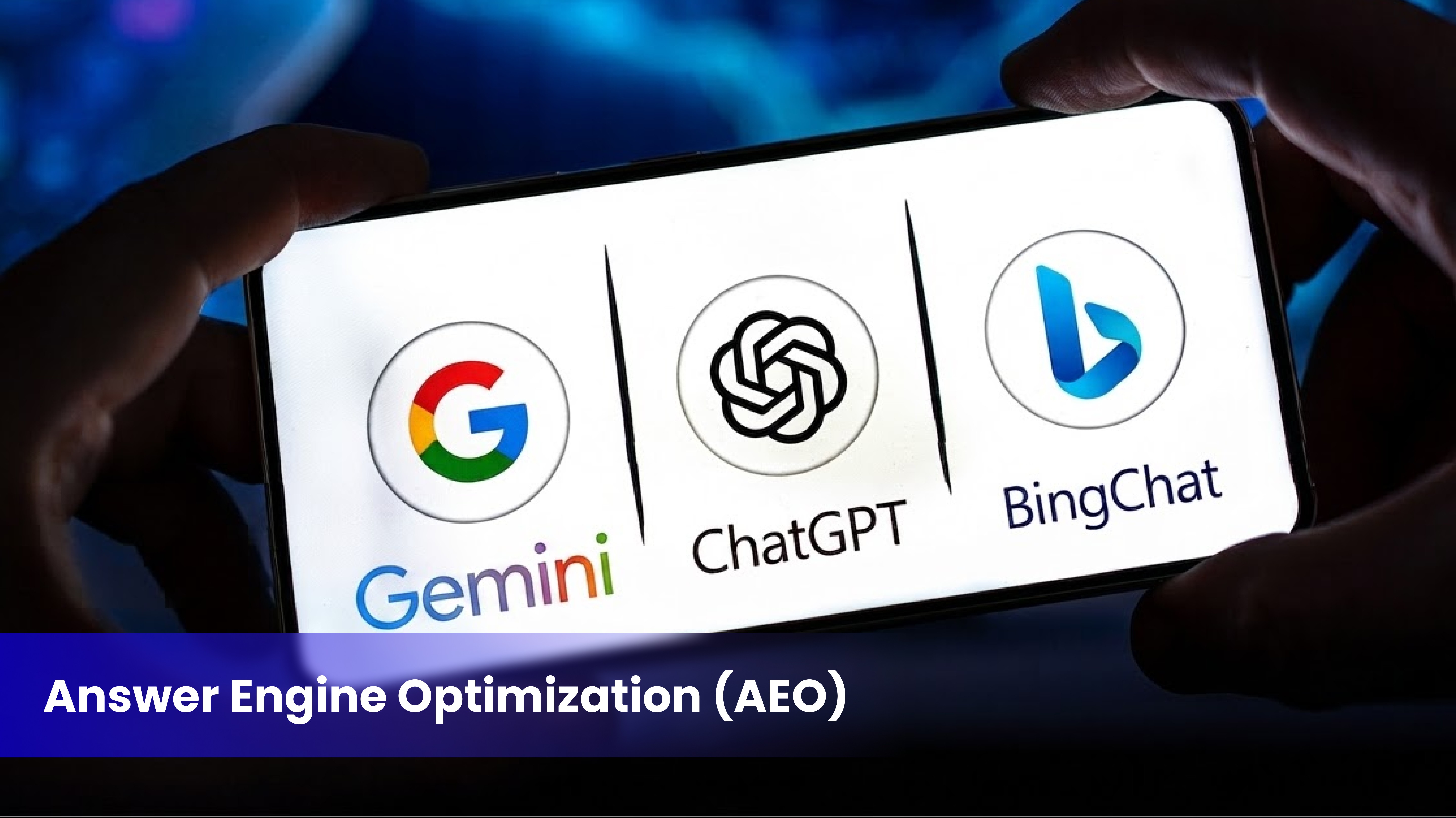
AEO is the optimization of web content that is targeted to be pulled directly into Answer Engines, which are applications that provide immediate answers to users, rather than a list of results.
How AEO Works
AEO fuels mostly voice search and conversational search, while various AI Assistants (Siri, Alexa, and Google Assistant) and featured snippets, that are the "boxed answers" that show above search results, are governed by AEO as well.
AEO Optimization Techniques
To succeed at AEO, you need to understand search intent and mirror the questions users ask. Employ structured data (schema), and have a well-organized FAQ. Answer Engines easily pull content from websites that are user-friendly and have content that is clean.
What is Generative Engine Optimization (GEO)?
GEO is the latest addition to the layers of search optimization. It is designed specifically for search generative AI tools like ChatGPT, Gemini, and Perplexity. Unlike traditional search tools, these tools synthesize information.
How GEO Supports AI Search
GEO is designed to situate your content for possible inclusion in AI search result citations generated by Large Language Models (LLMs). Because these models respond to prompts with AI-generated content that consists of information synthesized from multiple sources, contextual search is essential to content citation.
GEO Best Practices
GEO is built on the foundations of semantic search engine optimization, mastery of topic scope, and the absolute application of the standards for EEAT (Experience, Expertise, Authoritativeness, Trustworthiness). The likelihood of being cited by generative engines improves with the publication of genuinely useful information, the upkeep of content, and enhancement of the authority of the brand across all domains.
SEO Vs AEO Vs GEO: Key Differences
Factor | SEO | AEO | GEO |
Platform Focus | Search engines | Answer engines | AI search platforms |
Ranking Signals | Backlinks, keywords, technical SEO, page experience | Structured data, direct answers, content clarity | Semantic relevance, topical authority, citations, contextual trust |
Content Formats | Long-form pages, blogs, landing pages | FAQs, featured snippets, concise answers, voice-friendly content | Conversational, comprehensive, well-sourced content |
Search Visibility | Ranked search listings | Featured answers and snippets | AI-generated summaries and responses |
User Intent | Broad, keyword-driven searches | Specific, question-driven searches | Conversational and exploratory queries |
Customer Journey | Awareness to conversion | Quick answers, typically mid-funnel | Research, comparison, and decision support |
Organic Traffic | Click-through based | Lower clicks but higher visibility | Often zero-click, driven by AI brand mentions and citations |
Content Performance | Keyword rankings and organic traffic | Featured snippet capture rate and answer visibility | AI citation frequency and brand inclusion in AI responses |
Building a Future-Ready Content Strategy
Bringing all three approaches together into one integrated content strategy is the ideal way of maximizing visibility. The first step in this direction is the creation of topic clusters. This is where related articles are created around a main article (pillar pages) on a specific topic. Multiple related articles linked to a single article demonstrate to search engines and AI that you are knowledgeable on the topic of the article and not on the individual article.
The next step is the smart content distribution. Content should be shared throughout your website, social media, email, and every other channel. This way, your content will be found wherever people are searching or scrolling. Marketing analytics should be applied to understand what content is performing well and should be coupled with the regular measurement of ROI to know what content is worth producing.
Constant performance tracking will let you see the need for improvement or add resources to what is working. The last step in the process is to achieve truly omnichannel marketing. This is where your brand will be present in every search engine, social platform, or AI and not just one of them.
Level Up Your Content Marketing with Digital Factory 24
Simultaneously adapting to SEO, AEO and GEO can be incredibly challenging. Traditional search engines and AI search are both powerful and understanding how to maximize both of their potentials requires a unique skill. Enter Digital Factory 24.
Digital Factory 24 employs a multifaceted long-term SEO strategy and AEO optimization, increasing the likelihood of your content winning a coveted feature spot or becoming the answer for voice searches. Their work with GEO optimization ensures your brand will likely be cited in an AI-generated response by ChatGPT and other AI engines. Their AI solutions also help businesses leverage artificial intelligence to improve digital processes, automation, and overall marketing performance.
Digital Factory 24 employs a more extensive AI content optimization strategy. When paired with their content marketing services, your business can anticipate an increase in AI visibility, voice searches, and most importantly, the organic growth of your clientele. Because Digital Factory 24 is a Digital Marketing agency you can trust, their work will help you remain competitive, regardless of how your potential clients are using search engines.
Conclusion
SEO, AEO, and GEO are each component of the same strategy. The aim is to remain discoverable no matter how the user opts to search. SEO establishes the foundation. AEO accomplishes the direct answer. GEO captures the AI-generated search response.
The integration of all three components provides the organizations that utilize the competitive advantage of an innovative, integrated search framework, which promotes sustained organic growth. With the rapid proliferation of AI tools, the necessity of AI search is apparent. It provides an integrated framework of search that is the future of content marketing. The collaboration of an established digital marketing firm will facilitate the implementation of the framework.
Frequently Asked Questions


