How Generative AI Is Reshaping Content Marketing


Introduction
Nowadays, many marketers and businesses approach content marketing using Generative AI. Companies that once relied on small content teams and manual research now use Artificial Intelligence tools to support AI content creation, improve SEO efforts, and deliver more personalized experiences.
Rather than replacing human creativity, generative AI helps marketers generate ideas, create high-quality content, and strengthen their content strategy using audience insights and performance data. Its role in digital marketing and marketing automation is helping organizations improve productivity, connect with customers more effectively, and support business growth.
In this blog, we will explore how generative AI is transforming content creation, SEO, personalization, long-term content marketing strategies, and what these changes mean for modern businesses
The Rise of Generative AI in Content Marketing
What Is Generative AI?
Generative AI refers to systems built on Large Language Models (LLMs) that use Machine Learning and Natural Language Processing (NLP) to create human-like text, images, and other forms of content. These AI tools learn from large datasets and generate new material based on user prompts.
For content marketers, this supports AI content generation and AI content creation across tasks such as drafting blog posts, summarizing research, writing product descriptions, and creating social media content.
Why Businesses Are Adopting AI
Businesses are adopting AI for several practical reasons:
Content scalability across channels
Improved productivity
Better cost efficiency
Support for marketing automation
Workflow optimization
Greater competitive advantage
These benefits help marketing teams produce AI-generated content more efficiently while dedicating more time to strategy, creativity, and audience engagement.
Evolution of Content Marketing
Traditional content marketing relied on manual research, writing, and editing processes. AI-assisted workflows have helped reduce the time required for many of these tasks, making content innovation more accessible.
This change reflects a broader digital transformation across marketing departments. Today, content marketing strategies incorporate AI throughout the content lifecycle, from content planning and creation to publishing and performance analysis.
How AI Is Transforming Content Creation and Content Strategy
AI-Powered Content Research
AI is helping marketers strengthen content marketing strategies by improving the research process.
Keyword research
Search intent analysis
Audience research
Competitor analysis
Content brief creation
Topic discovery
By organizing large amounts of information quickly, AI helps teams identify relevant topics and content opportunities with less manual effort. It also provides a stronger foundation for content strategy.
Smarter Content Creation
An AI content generator can support blog writing, website copywriting, landing pages, service pages, social media content, and email marketing. These tools help marketers create draft content, explore different messaging approaches, and develop variations for specific audiences.
While AI-generated content can speed up production, human oversight remains important for accuracy, context, and brand consistency.
Strategic Content Planning
AI also plays a growing role in content marketing services by supporting long-term planning and content management. Marketers use AI to:
Organize topic clusters
Develop pillar pages
Build editorial calendars
Conduct content gap analysis
Review alignment with brand voice
Identify content optimization opportunities
This allows teams to make decisions and maintain a more consistent approach throughout the content lifecycle.
Improving SEO Performance with AI-Powered Content Optimization
AI-Driven SEO Strategies
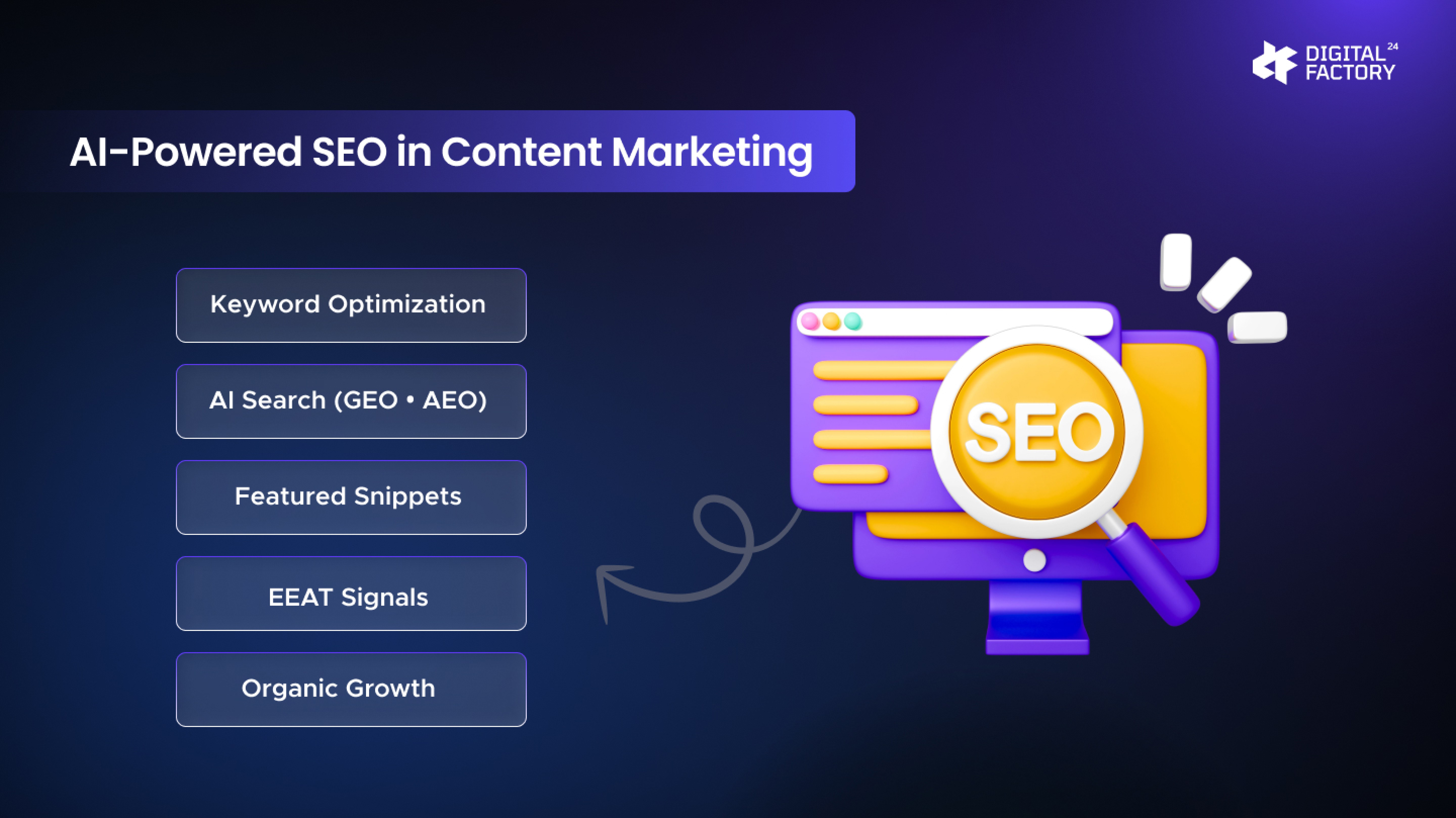
Generative AI is playing a larger role in SEO by helping marketers improve semantic SEO and on-page SEO efforts. These tools can identify keyword optimization opportunities, including valuable long-tail keywords that may be overlooked during manual research.
By analyzing search patterns and user behavior, AI helps create content that aligns more closely with audience interests. This can improve search visibility and support steady growth in organic traffic over time.
Optimizing for AI Search
Search behavior continues to evolve, with AI search becoming an important part of how users find information. As a result, Generative Engine Optimization (GEO) and Answer Engine Optimization (AEO) are gaining attention alongside traditional SEO practices.
Businesses are creating content designed for featured snippets, AI-generated responses, and search rankings. Clear structure, direct answers, and strong content relevance can improve the chances of appearing in these search experiences
Building Long-Term Organic Authority
AI can also support long-term SEO efforts by identifying internal linking opportunities and highlighting gaps in EEAT (Experience, Expertise, Authoritativeness, and Trustworthiness) signals.
Strong brand authority still depends on publishing evergreen content and maintaining content freshness through regular updates. While AI can identify pages that need attention, human expertise remains important for improving content quality and user experience.
Personalization and Customer Engagement Through AI
Delivering Personalized Experiences
Generative AI helps content marketing services deliver personalization through audience segmentation, dynamic content, and behavioral insights. By analyzing the customer journey, marketers can create more relevant messaging and improve the overall customer experience.
Enhancing Engagement with AI
In B2B content marketing, AI supports lead nurturing and marketing automation by providing AI recommendations based on customer behavior. These insights can improve customer retention, increase user engagement, and support conversion optimization across different marketing channels.
Measuring Content Performance
Effective content marketing strategies rely on measuring results. Marketing analytics and performance tracking help teams evaluate ROI and understand customer insights. Regular KPI monitoring and Conversion Rate Optimization (CRO) efforts allow businesses to identify successful content, improve customer engagement, and make informed decisions about future campaigns.
Challenges and Best Practices for AI Content Marketing
Maintaining Content Quality
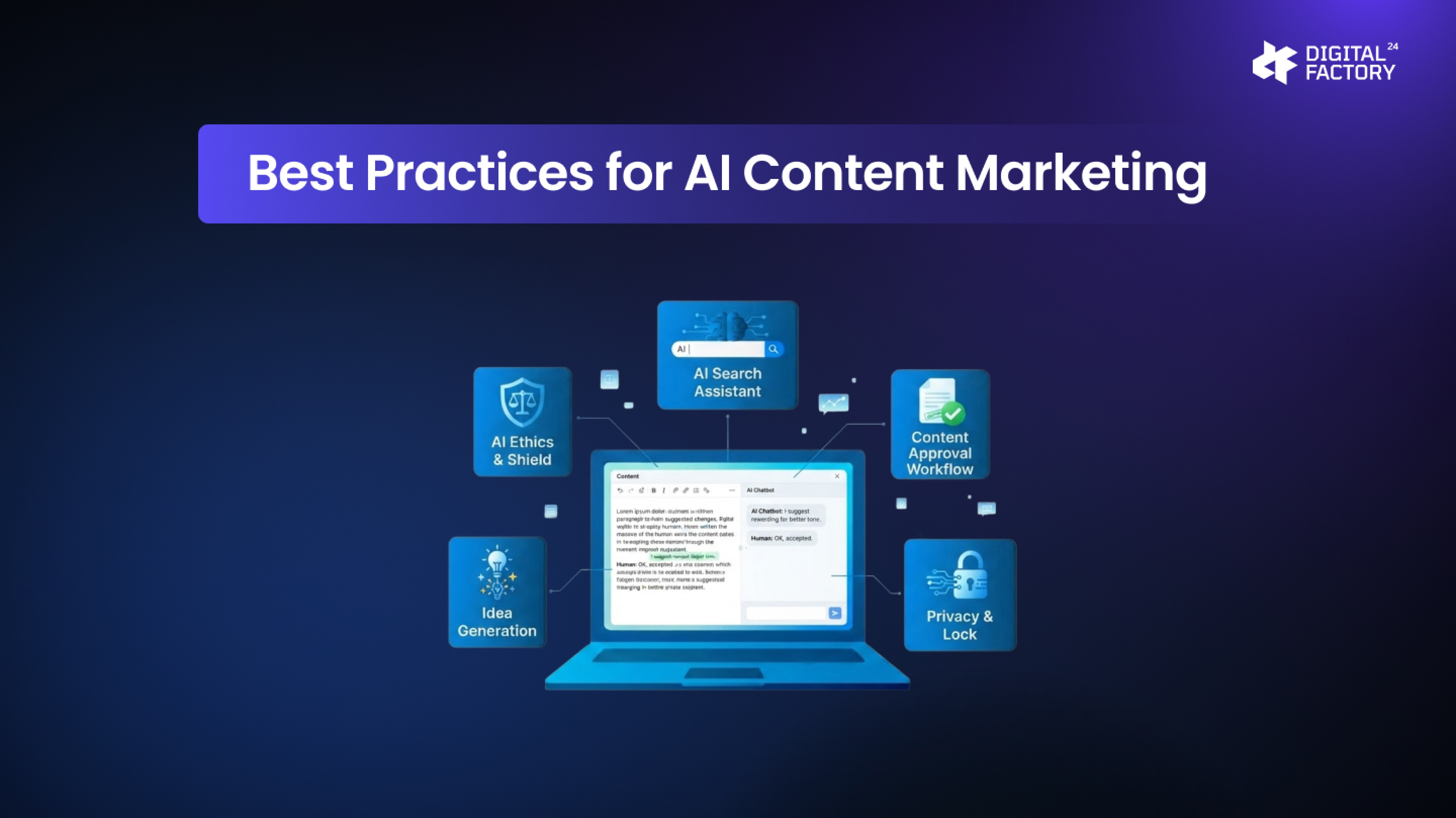
AI-generated content can speed up production, but it still requires careful review. Original content, fact checking, and human editing remain important parts of the publishing process.
Both search engines and readers value helpful content that provides accurate information. Without editorial oversight, businesses may face content accuracy issues and inconsistencies in brand consistency.
Ethical AI Implementation
As generative AI becomes more common, organizations must address AI ethics, copyright compliance, and data privacy.
Transparency about how AI is used in content creation can strengthen audience confidence. Responsible AI practices help businesses build trustworthiness while supporting sustainable content marketing strategies.
Balancing AI and Human Creativity
In B2B content marketing, AI can assist with research and drafting, but strong brand storytelling depends on human expertise. Creative writing, thought leadership, and content authenticity come from people who understand audience needs and brand values. The most effective teams use AI as a support tool while maintaining editorial review and human judgment throughout the content creation process.
Why Choose Digital Factory 24 for AI-Powered Content Marketing?
AI-Driven Content Strategy
As a content marketing agency, Digital Factory 24 develops content planning strategies aligned with business objectives. By combining SEO strategy, generative AI, and AI integration, we create targeted campaigns that support business growth and improve audience targeting through data-driven insights.
SEO-Optimized Content Services
Our content marketing services include:
SEO copywriting
Content optimization
Internal linking
Topic cluster development
Organic visibility improvements
Performance-Focused Digital Marketing
Digital Factory 24 helps businesses achieve their marketing goals through data-driven digital marketing strategies. We use marketing analytics to measure lead generation, customer acquisition, and ROI measurement across campaigns. Through continuous optimization, we refine content performance over time, helping businesses improve the value of their content investments and achieve measurable outcomes.
Conclusion
Generative AI is now a regular part of content marketing, helping businesses improve SEO, strengthen customer engagement, and support business growth. From content research and creation to optimization and performance analysis, AI influences many areas of digital marketing. However, technology alone does not produce strong results.
Effective content marketing strategies still rely on clear goals, audience understanding, and human expertise. When combined with a solid marketing strategy, AI innovation can help brands create relevant, valuable content that resonates with customers.
Digital Factory 24 helps businesses achieve measurable marketing results through Generative AI, Content Marketing, SEO, and Digital Marketing services. Supported by expertise in Artificial Intelligence, Enterprise Web Development, Drupal Development, Cloud Infrastructure, and Digital Product Engineering, we help brands drive sustainable growth.
Frequently Asked Questions


