What Is Enterprise Ecommerce Development? A Complete Guide for Modern Businesses


Introduction
A basic online store works well until it can no longer keep pace with business growth. When companies expand into new markets, manage thousands of SKUs, or handle large traffic volumes during sales events, standard ecommerce platforms often struggle to keep up. That's when many businesses start evaluating enterprise ecommerce website development options.
Enterprise ecommerce development involves building large-scale, highly customized platforms that support complex operations, high transaction volumes, and long-term growth. Unlike template-based solutions, custom ecommerce development gives businesses the flexibility to connect core systems, support unique workflows, and adapt to changing requirements.
For a growing enterprise online store, scalability, artificial intelligence, integrations, and security are critical. A scalable ecommerce platform can handle changing demand, while connected systems improve data visibility across the business. Strong security protects customer information and transactions. This guide explores what enterprise ecommerce development involves, why it matters, and how digital commerce solutions support sustainable business growth.
What is Enterprise Ecommerce Development?
Key Characteristics
As part of broader enterprise digital commerce strategies, these platforms typically offer:
Scalability to support growing traffic and transaction volumes
Advanced customization to match unique business requirements
Integration with ERP, CRM, payment, and inventory systems
Support for multiple storefronts, currencies, and languages
Built-in security and compliance capabilities
Difference from Small Business Ecommerce
Small business stores often rely on hosted solutions with limited customization and fewer operational requirements. In contrast, enterprise commerce architecture supports multiple storefronts, currencies, languages, and backend integrations.
As a result, enterprise businesses require more advanced enterprise retail technology to manage large product catalogs, complex workflows, and growing customer demands.
Why Enterprise Businesses Need Specialized Ecommerce Development
High Traffic Handling
Enterprise businesses require platforms built for high traffic ecommerce environments. Strong website scalability and ecommerce performance optimization help maintain fast browsing and checkout experiences during traffic surges.
Multiple Product Catalogs
Managing products across brands, regions, and business units requires strong product catalog management. An enterprise product catalog supports complex product data, while catalog management software helps keep inventory and pricing information accurate.
Multi-Store Management
Many organizations operate several storefronts across markets. Multi-store ecommerce systems support centralized storefront management while allowing each brand to maintain a unique customer experience. This is particularly important for multi-brand ecommerce operations.
Global Expansion
International growth requires global ecommerce capabilities such as multi-language ecommerce support, localized payment options, and multi-currency ecommerce pricing to serve customers across regions.
Complex Customer Journeys
Enterprise customers interact across multiple channels before making a purchase. Supporting an omnichannel customer journey improves customer experience optimization and creates a consistent, personalized shopping journey across every touchpoint.
Core Features of an Enterprise Ecommerce Platform
AI-Powered Search
AI-powered ecommerce search helps customers find products faster by understanding intent, correcting errors, and delivering more relevant results through intelligent product search and semantic search capabilities.
Personalized Shopping Experiences
AI personalization uses customer behavior and purchase history to create a personalized shopping experience. Features such as personalized content and product recommendations can improve engagement and sales.
Advanced Product Management
A strong product information management system centralizes product data across channels. It supports enterprise merchandising and efficient product lifecycle management from launch to retirement.
Multiple Payment Gateways
Payment gateway integration allows businesses to support regional payment preferences. Combined with secure payment processing, modern online payment solutions help improve transaction flexibility.
ERP Integration
ERP integration connects the ecommerce platform with enterprise resource planning systems that manage inventory, finance, and operations. Effective backend system integration keeps order data, stock levels, and business records synchronized across departments.
CRM Integration
CRM integration helps businesses connect ecommerce activity with customer relationship management systems. Centralized customer data management gives sales, marketing, and support teams better visibility into customer behavior, purchase history, and engagement
Inventory Management
An inventory management system supports effective stock management through real-time inventory tracking across warehouses and sales channels.
Headless Commerce
Headless commerce uses an API-first commerce model and decoupled architecture, allowing businesses to create flexible digital experiences across multiple channels.
Mobile Commerce
As mobile commerce continues to grow, platforms must support responsive ecommerce experiences optimized for mobile shopping behaviors and faster checkouts.
Enterprise Security
Enterprise ecommerce security includes encryption, access controls, and fraud prevention. PCI compliance and strong ecommerce cybersecurity practices help protect customer and business data.
Enterprise Ecommerce vs Traditional Ecommerce
Factor | Traditional Ecommerce | Enterprise Ecommerce | |
|---|---|---|---|
Scalability | Limited, often capped by hosting plan | Built for horizontal scaling and traffic spikes | |
Security | Basic SSL and standard protections | Advanced encryption, PCI compliance, fraud detection | |
Customization | Theme and plugin based | Custom-built at the code level | |
Integrations | Few, often limited to basic apps | Deep integration with ERP, CRM, and other systems | |
Performance | Adequate for moderate traffic | Optimized for high volume and speed at scale | |
AI Capabilities | Minimal or add-on based | Built-in personalization, search, and analytics | |
User Roles | Single admin or small team | Complex permission structures for large teams | |
Global Operations | Single currency and language typical | Multi-currency, multi-language, multi-region support |
Benefits of Enterprise Ecommerce Development
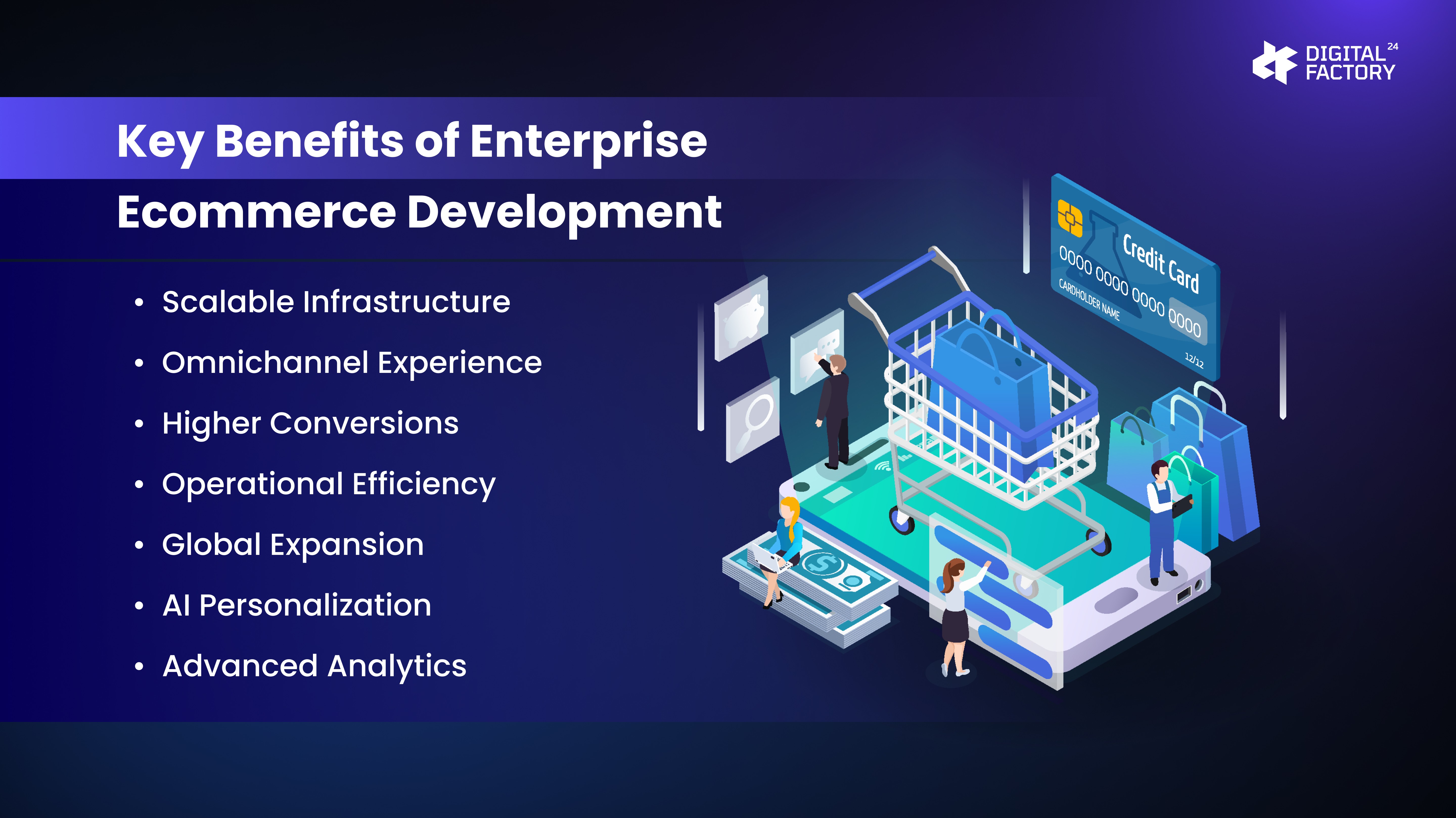
Key enterprise ecommerce benefits include:
Faster business growth through scalable infrastructure.
Better customer experience with personalized interactions and consistent omnichannel journeys.
Higher conversion rates through improved search, recommendations, and checkout processes.
Increased operational efficiency with ERP and CRM integrations that reduce manual tasks.
Global scalability to support expansion across markets and regions.
AI-driven personalization based on customer behavior and preferences.
Better decision-making through ecommerce analytics and real-time business insights.
Key Technologies Used in Enterprise Ecommerce Development
A modern ecommerce technology stack combines several technologies to support performance and scalability:
AI and Machine Learning for search, personalization, and forecasting.
Cloud infrastructure to handle changing traffic demands.
APIs and microservices architecture for flexible integrations and development.
Headless Commerce and progressive web apps for fast, device-friendly shopping experiences.
Analytics for customer and performance insights.
DevOps for ecommerce to support efficient deployments and updates.
CDNs to improve page load speeds across global markets.
Enterprise Ecommerce Development Process
The ecommerce development process for enterprise platforms follows a structured approach within the broader software development lifecycle.
Discovery: Define business goals, challenges, and technical requirements.
Business Analysis: Document workflows, user roles, and system dependencies.
UX/UI Design: Create user-friendly experiences for customers and internal teams.
Architecture Planning: Establish the solution architecture, including integrations, commerce models, and scalability requirements.
Development: Build platform features based on approved designs and technical plans.
Integration: Connect ERP, CRM, payment gateways, and other business systems.
Testing: Validate functionality, performance, and security before launch.
Deployment: Launch the platform through a planned enterprise implementation strategy.
Optimization: Use performance data and user feedback to support ongoing improvements
Common Challenges and How to Overcome Them
Enterprise businesses often face several obstacles during digital transformation initiatives:
Legacy system integration: Address enterprise integration challenges through legacy modernization and experienced development support.
Data migration: Use a phased ecommerce migration strategy to reduce data errors and disruptions.
Performance bottlenecks: Conduct load testing early to identify issues before launch.
Security compliance: Build compliance requirements into the platform architecture from the start.
Multi-channel complexity: Maintain consistent data across storefronts and sales channels.
AI adoption: Focus on clear objectives and quality data to support effective ecommerce optimization.
Choosing the Right Enterprise Ecommerce Development Company
Enterprise ecommerce projects often encounter technical and operational challenges that can affect performance and growth.
Legacy system integration: Older ERP, inventory, and business systems may not connect easily with modern platforms. Addressing these enterprise integration challenges often requires a planned legacy modernization approach.
Data migration: Moving customer, product, and order data can be complex. A phased ecommerce migration strategy helps reduce errors and downtime.
Performance bottlenecks: Traffic surges can impact site speed and checkout performance. Load testing helps identify issues before they affect customers.
Security compliance: Regulatory and payment security requirements should be considered early in the development process rather than after launch.
Multi-channel complexity: Managing data across websites, marketplaces, and physical stores requires strong governance and consistency.
AI adoption: Successful use of AI depends on clear business goals and reliable data, making it an important part of ongoing ecommerce optimization and digital transformation efforts.
Future Trends in Enterprise Ecommerce Development
The future of ecommerce is being shaped by technologies that support smarter and more flexible shopping experiences.
Agentic AI is beginning to automate tasks such as customer support and inventory decisions.
AI shopping assistants help customers find products and make informed purchasing choices.
Voice commerce and visual search offer new ways to discover and buy products.
Composable commerce and headless architecture provide greater flexibility for building digital experiences.
Predictive analytics help businesses forecast demand and plan inventory more effectively.
Hyper-personalization delivers tailored content and recommendations.
Autonomous merchandising uses AI to adjust pricing, promotions, and product placement based on customer behavior.
Conclusion
Enterprise ecommerce development helps organizations build scalable digital commerce platforms that can support growing customer demands, complex operations, and evolving market requirements.
With the right architecture, integrations, and security practices, businesses can create an AI-ready ecommerce platform capable of supporting personalization, automation, and ongoing ecommerce innovation. These capabilities play a key role in long-term growth and successful enterprise digital transformation initiatives.
Digital Factory 24 helps organizations build scalable and secure commerce platforms through its Enterprise Ecommerce Development expertise. In addition, businesses can leverage our Enterprise Web Development, Artificial Intelligence, Cloud Infrastructure, DevOps Engineering, Drupal Development, and Digital Marketing services to support long-term digital growth.


