AI in Digital Marketing: How It’s Changing SEO in 2026

Introduction to AI in Digital Marketing
Not long ago, digital marketing relied on keyword‑heavy content and backlinks to gain visibility. That approach no longer works on its own as search and marketing works differently today.
AI is now shaping how digital marketing works, from how search engines interpret content to how emails reach users at the right time. In simple terms, AI in digital marketing uses data and language understanding to make marketing decisions faster and more accurate. Search engines now focus on meaning, context, and intent rather than just matching keywords.
The year 2026 marks a turning point. More users rely on AI‑powered search tools to find information, often without clicking through websites. For businesses that depend on online visibility, understanding how AI is changing SEO optimization is no longer optional. It is essential to stay competitive.
How AI is Transforming Search Engine Optimization (SEO)
Search Engines Now Read Intent, Not Just Keywords
Search engines like Google and Bing no longer scan pages only for matching keywords. Their systems now try to understand what a user is actually trying to achieve. For example, someone searching for “best running shoes for flat feet” is not just looking for product names. They want comparisons, practical advice, and reassurance.
This shift from keyword matching to intent understanding means content must answer real questions clearly. Writing for people and writing for search are now closely aligned.
AI-First Search Engines Are Now Part of the Game
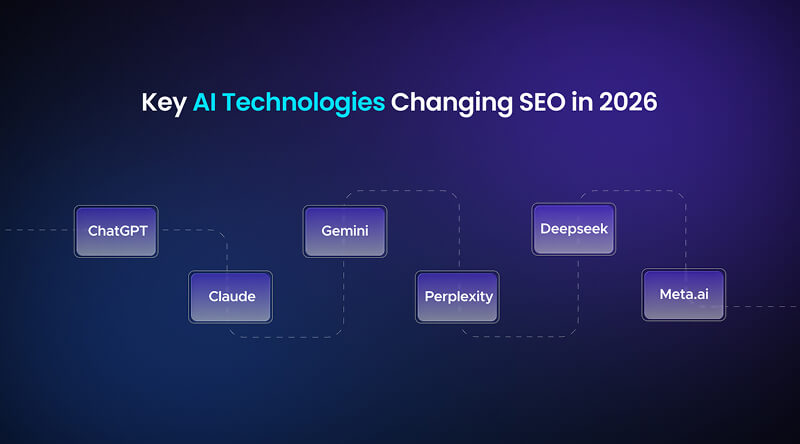
Search is no longer limited to traditional search engines. Tools like ChatGPT, Google Gemini, and Perplexity have become common starting points for finding information. Many users move between multiple platforms before making a decision.
For businesses, this changes the visibility game. Content needs to appear wherever people ask questions, not just on standard search results pages.
From Keywords to Context and Entities .
Modern SEO is less about targeting individual keywords and more about building authority around a topic. Search engines now recognize entities such as brands, services, and concepts, and understand how they relate to one another.
A digital marketing agency, for instance, gains visibility not by publishing a single article on social media management, but by covering related topics in depth. This connected content signals expertise and trust. The best digital marketing agency builds topical authority across a wide range of interconnected subjects, rather than targeting isolated keywords.
The Organic Traffic Equation Has Changed
AI generated summaries increasingly appear at the top of search results. When these summaries are shown, users often get answers without clicking through to a website.
As a result, traditional click through rates have declined in many industries. Gaining visibility today often means being referenced inside AI responses, not just ranking below them.
Key AI Technologies Changing SEO in 2026
Generative AI and Content Creation
AI writing tools have changed how marketing teams create content. Tools like ChatGPT, Claude, and Gemini are now commonly used for research, outlines, drafts, and edits. When used well, they help teams move faster without sacrificing quality.
The problem starts when AI is used to publish large volumes of generic content. Many sites doing this are already seeing drops in rankings due to low‑quality pages. The teams seeing success use AI as a support tool, then add original thinking, real experience, and a clear point of view. This is what separates a strong ai content marketing approach from one that simply produces noise.
Search engines in 2026 reward content that shows expertise and first‑hand knowledge. AI can help with speed, but it cannot replace insight.
AI-Powered Keyword Research
Keyword research has moved beyond finding high‑volume phrases. AI‑powered tools now help identify topics before they peak and group related searches by user intent.
For example, someone searching “how much does social media management cost” is looking for pricing, while “what does social media management include” signals a need for explanation. AI tools can separate these intents, allowing content to match what the user actually wants. This leads to better engagement and stronger conversions.
Voice Search and Conversational AI
Voice search is now part of everyday behavior. People ask full questions using natural language when speaking to phones and smart devices. These queries are longer, more specific, and closer to how people talk.
Optimizing voice search means writing clear answers, using natural sentence structure, and addressing questions directly. FAQ sections, question‑based headings, and short opening answers help content perform better in voice and conversational search results.
AI in Technical SEO
Technical SEO has become more automated with the help of AI. Tools now scan websites for crawl issues, broken links, slow pages, duplicate content, and structural problems that once required manual audits.
Structured data also plays a bigger role than before. Schema helps search engines and AI systems understand what a page represents, whether it is a product, a local business, or a guide. For businesses focused on local seo services, correct schema markups can determine whether they appear in AI‑generated results or not.
Rise of New SEO Concepts
Generative Engine Optimization (GEO)
Generative Engine Optimization (GEO) focuses on structuring content, so AI platforms cite, mention, or recommend your brand when users ask relevant questions. The goal is not only to rank in search results, but to be selected as a trusted source by tools like ChatGPT, Gemini, Perplexity, and Google AI Overviews.
Research shows that brands are far more likely to be cited in AI answers through third party mentions than through their own websites alone. This makes digital PR, guest publishing, and visibility on trusted platforms increasingly important.
Answer Engine Optimization (AEO)
Traditional SEO asks whether a page ranks on Google. AEO asks whether a brand appears correctly inside AI-generated answers. The focus shifts from ranking pages to owning the answer.
This requires content that is easy for AI systems to extract and reuse. Clear question and answer formats, FAQ sections, structured data, and natural conversational writing all play a role in improving AEO performance.
AI Overviews and Zero-Click Searches
Google now shows AI generated summaries at the top of many search results. In these cases, users often read the summary and leave without clicking any links. This behavior is known as a zero click search.
For informational queries, zero click searches are becoming common. Businesses need to think beyond traffic and focus on brand visibility within these summaries.
LLM Visibility
Being mentioned by tools like ChatGPT or Gemini is becoming as valuable as ranking on the first page of Google. AI platforms tend to reference well established sources such as Wikipedia, Reddit, and major publications.
Building a presence on trusted third-party platforms is now part of a complete SEO strategy. Visibility across these sources increases the chances of being referenced in AI-generated responses.
AI-Powered Digital Marketing Channels
AI in Content Marketing
In 2026, AI helps content marketing teams personalize content at scale and plan ahead. A well-structured content marketing strategy now relies on AI to deliver different versions of pages, emails, or ads to different users based on their behavior and past interactions. AI also supports predictive content planning by spotting patterns in audience interest, allowing teams to create content before demand peaks instead of reacting after it does. Businesses investing in professional content marketing services gain a significant edge by combining AI-driven insights with human creativity to produce content that resonates and ranks.
AI in Paid Advertising (PPC)
AI has changed how paid ads are managed by automating bidding and improving targeting. Bids are adjusted in real time based on factors like search intent, timing, device, and competition. Audience targeting now focuses on behavior rather than just age or location, which leads to better ad performance and lower cost per click.
AI in Social Media Marketing
Social media teams use AI to understand when audiences are most active, which content formats perform best, and which trends are gaining attention. Effective social media management today relies on AI tools to test multiple creative variations quickly and identify what works. Behavioral targeting helps ads reach users based on their actions, which improves relevance and engagement. Brands that invest in dedicated social media marketing services are better positioned to respond to trends in real time and maintain a consistent presence across platforms.
AI in Email Marketing
AI has made email marketing more precise and effective. Personalization at scale allows each subscriber to receive content based on their interests and stage in the buying journey. AI also analyzes past behavior to predict the best time to send emails, which improves open rates and overall campaign performance.
How AI Improves Conversion Rate Optimization (CRO)
Getting traffic to a website is only the first step. Converting visitors into customers is where AI solutions make a real difference — specifically, AI powered CRO tools that go far beyond standard analytics.
AI tools study user behavior in detail, including clicks, scrolling patterns, and where users drop off during checkout. This insight supports AI driven A B testing that runs faster and tests more variations than traditional methods, helping teams identify what works sooner.
Personalized landing pages build on this approach. Instead of showing the same page to every visitor, AI adjusts headlines, visuals, and calls to action based on the visitor’s source and intent. Someone searching for ecommerce SEO services may see different messaging than a visitor arriving from a social media ad, which improves relevance and conversion rates.
Benefits of AI in Digital Marketing
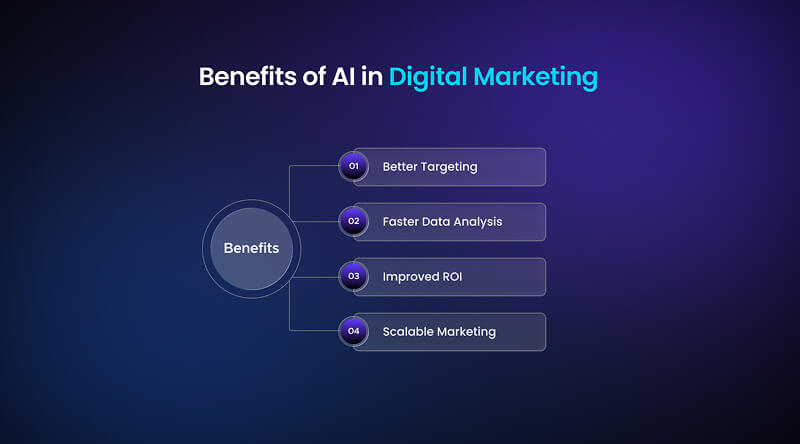
Better targeting and personalization
AI can process more signals about a user's intent and behavior than any human analyst, leading to marketing that feels relevant rather than intrusive.Faster data analysis
Campaigns that once took weeks to evaluate can be analyzed in hours. Decisions that previously relied on gut feel are now backed by real-time data.Improved ROI
Smarter targeting, better content, and automated optimization across channels means every marketing dollar goes further. Businesses using AI-driven marketing consistently report better returns on their content marketing strategy investment.Scalable marketing
Small teams can now produce the volume and quality of marketing that previously required large departments. AI handles the repetitive tasks; your team focuses on strategy and creativity
Challenges and Limitations of AI in SEO
Over-reliance on AI tools
When teams let AI tools drive every decision, they lose the strategic judgment. Technology can optimize what is measurable, but many important marketing decisions still require human context, experience, and intuition.
Content quality concerns
Mass-produced content is easy for readers and search engines to recognize. Pages created only to target keywords rarely build trust or authority. In 2026, content needs depth, originality, and real insight to perform well.
Algorithm dependency
SEO strategies that depend on a single platform or algorithm are fragile. One major update can undo months of work. Spreading effort across multiple channels and content formats helps reduce this risk.
Ethical and data privacy issues
Personalization relies on user data. As privacy laws tighten, businesses must be transparent and responsible in how data is collected and used. Customers increasingly choose brands they trust with their information.
How Digital Factory 24 Delivers AI-Driven Digital Marketing Services?
At Digital Factory 24, we treat AI as a practical tool, not a shortcut. As a trusted digital marketing agency USA businesses rely on, we use AI to build digital marketing strategies that are data‑led, efficient, and designed for long‑term results.
Our AI‑powered SEO approach goes beyond keyword rankings. We optimize content and brand visibility across Google, AI Overviews, ChatGPT, Gemini, and other platforms where customers search for answers.
Our keyword and intent research use predictive analysis to identify what audiences are likely to search for next. This allows us to build content strategies around real buying intent rather than surface level metrics.
Content built for AI search is structured so systems can read, understand, and reference it correctly. Clear headings, schema markup, FAQ sections, and authoritative sources are part of every deliverable.
Our digital marketing campaigns cover paid advertising, social media, and email marketing. Each channel is guided by performance data and refined continuously through testing and optimization.
As a full‑service digital marketing partner, we bring together local SEO services, ecommerce SEO, content marketing strategy, social media management, and paid media into a single plan. This keeps all channels aligned with the same business goals and strengthens overall results.
Future of AI in SEO and Digital Marketing
The next few years will bring changes that make today's landscape look simple.
Hyper personalization will expand further. Content, ads, and emails will be tailored for each individual user based on their behavior, preferences, and context, rather than broad audience segments.
Predictive search behavior will continue to improve. AI systems will begin to understand user intent before questions are fully formed. Search will feel more like an ongoing conversation with a knowledgeable guide than a traditional query.
AI driven search results pages will keep evolving. The familiar list of links already appears less often in many searches. Businesses that adapt their digital presence for AI first discovery will gain an early advantage.
The balance between automation and human creativity will remain critical. Successful brands will use AI for speed, scale, and data analysis while keeping human judgment, creativity, and expertise at the center of their marketing strategy.
Conclusion
AI has changed how SEO works at a fundamental level. The focus is no longer only on ranking pages higher, but on becoming the source that search engines and AI systems choose to answer user questions. As AI powered search becomes more common, visibility depends on authority, clarity, and relevance across multiple platforms.
Strong expertise, clear writing, and real value for readers matter more than ever, while shortcuts are increasingly penalized.
If you are ready to build a digital marketing strategy that works in 2026 and beyond, explore Digital Factory 24’s digital marketing services and start strengthening your visibility Ai today.