How Digital Marketing Increases Sales for E-commerce Businesses

In the current market, an impressive product catalog isn’t the only thing needed to sell products online. You will also need the right strategy to identify your target customer, convert website visitors to customers, and retain them for future sales. Digital marketing has the power to connect an online seller to their customers at any stage in the purchasing deal. This leads to increased e-commerce sales, better visibility, and improved customer retention. There are many forms of digital marketing that are impactful on e-commerce revenue streams, including search engines, ads, social media, and email marketing. In this blog, let’s discuss how digital marketing is the key to amplified e-commerce sales and ROI.
How Can eCommerce SEO Services Help Increase Sales Online?
Optimizing Category and Product Pages
Your product pages are your digital storefronts. Search engines identify well-structured data, schema markup, and product descriptions, ultimately directing qualified traffic to your core pages. The authority is further strengthened through site-wide interlinking.
Also, mobile-optimizing your website guarantees your customer will have the best shopping experience, no matter what the device. These practices are the backbone of successful e-commerce search engine optimization.
Improving Search Visibility
Ranking on page one is the ultimate target for any e-commerce platform. To get this right, businesses need to go after both broad search terms and long-tail keywords.
Snippets and AI search results (LLM) need to be optimized so potential customers can be reached beyond Google rankings. Consistent content publishing is the key to good organic visibility, and businesses that readily invest in e-commerce SEO services gain sustainable, and compounding results.
Improving User Experience
Search engines consider user experience as one of the most integral ranking factors. Core Web Vitals, for example, impact the placements of results of an organic search, and the length of time users preview a site. Bounce rates are low when the site is structured with easy navigation, leading to the point of purchase. Most search engines adopt mobile first indexing, meaning that an ecommerce site that has not considered its mobile format is potentially missing a lot of visits.
PPC Advertising and Conversion Growth
Running High-Converting Ad Campaigns
Paid search and shopping ads give you competitive keyword visibility that is challenging to achieve through organic rankings which take time to develop. The clearest way to direct potential customers from clicking an ad to buying a product is to use directed ad copy and target the right audience using well-optimized landing pages. Make sure the ad spends, clicks, and conversions are tracked continuously for the optimal use of the ad budget.
Retargeting Potential Customers
Most first-time visitors might not buy a product on their first visit. Remarketing campaigns help bring abandoned cart / bounced users back to the site by displaying the same product they viewed through various channels. Dynamic product ads for retargeting should be highly personalized, so that customers return to complete the order, or make repeated purchases.
Content Marketing Strategies for E-commerce
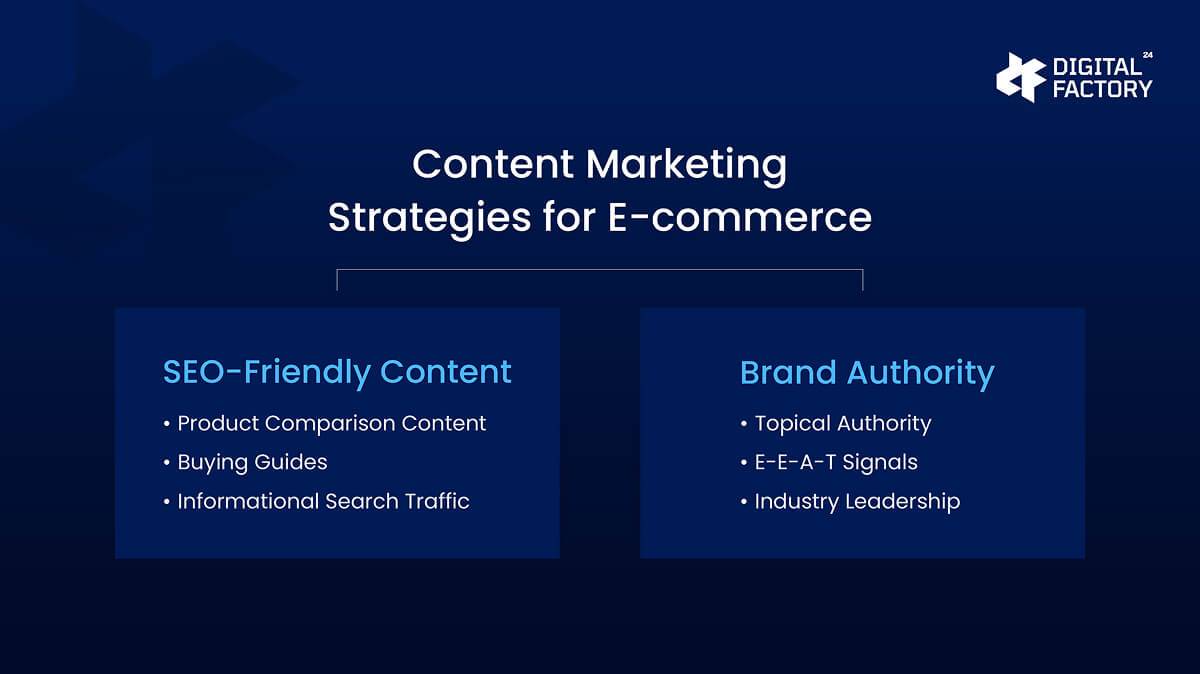
Creating SEO-Friendly Content
Before an ecommerce customer is ready to buy, they will most likely have a few pre-purchase questions that can be answered by content marketing. Potential customers can be targeted by product comparison and buying guides. These guides drive potential customers who are actively searching for your product.
Building Brand Authority
Google’s E-E-A-T (experience, expertise, authoritativeness, and trustworthiness) framework influences how content is ranked in search. Consistent content clusters with a good EEAT score and high topical relevance help build brand authority and position the business as a market leader.
Conversion Rate Optimization for Increased Revenue
Understanding and Defining the Customer Journey
Traffic is just the first half. Customer journeys let us understand where customers are dropping off and figure out what obstacles are preventing the conversion. Creating more streamlined and less friction experiences helps businesses strengthen their Ecommerce Solutions strategy and maximize conversions from existing traffic. Iterative enhancements are a must and help brands achieve significant short- and long-term financial impacts.
Reducing Cart Abandonment
Cart abandonment is when potential customers go most of the way through the conversion funnel but drop off prior to the actual completion of the purchase, or conversion. This is a challenge most growing e-commerce platforms today face. The best way brands usually increase cart recovery rates due to abandonment is by easing the checkout process, optimizing the payment gateway, improving trust signals, sending cart abandonment reminder emails and offering discounts.
Email Marketing and Customer Retention
Building an email list is one of the most cost-effective digital marketing strategies still in the ecommerce space. Automating marketing leads to less time creating marketing messages and allows for segmentation of audiences. Messaging ecommerce marketing emails that are promotional, follow-up and non-generic, are easier to send, but require a lot of thoughtful time to create.
Personalized Email Campaigns
The return on investment for marketing via email is the highest among the options available for digital marketing. With the help of email automation, customer segmentation, and AI Solutions, businesses can deliver highly personalized experiences that drive higher engagement and sales. Made promotional emails smarter with product recommendations and watch the sales grow in comparison to the broadcast messages.
Bringing Customers Back for Repeat Purchases
It is expensive to bring in a new customer; however, returning customers can be captured with loyalty programs, subscriptions, and marketing. The organizations that efficiently optimize the value of their customer base will have sustainable growth, and the rest remain stagnant. Customers that have been in the market once will have more spending and more advancing in sales with less time to be in the market.
Analytics & Performance Monitoring
Assessing the Value of Marketing
Improvement hinges on assessment. Numerous tools exist to assess traffic, KPIs, and conversion rate analyses. Use Google Analytics and Search Console to improve your analytic skills. E-commerce SEO companies and in-house SEO teams convert every action to real analytics.
Data-driven Decision Making
Analytics provide a peek into the surface layer, whereas user behavior and customer data analytics delve deeper to evaluate what incentives exist for user conversion. Performance reports for elevated ROIs allow marketing teams to do more of what works, and to do away with what doesn’t. Data analytic marketing strategies are the backbone of every scaling success.
SEO vs. PPC vs. Content: A Quick Comparison
Channel | Speed of Results | Cost Over Time | Best For |
|---|---|---|---|
SEO for Ecommerce | Slow (3-6 months) | Decreases over time | Long-term organic growth |
PPC Advertising | Immediate | Increases with scale | Quick wins and retargeting |
Content Marketing | Medium (2-4 months) | Low with compounding ROI | Authority and funnel coverage |
Email Marketing | Fast | Very low | Retention and repeat sales |
CRO | Medium | One-time investment | Maximising existing traffic |
Why Choose Digital Factory 24 for E-commerce Marketing
As a trusted e-commerce SEO agency and a tech-savvy partner with advanced AI-backed digital marketing solutions, several leading platforms of today join hands with us for accelerated growth and ROI.
Data-Driven Digital Marketing Solutions
At Digital Factory 24, we understand what it takes to efficiently run your online business. We combine our expertise in ecommerce digital marketing, performance marketing, lead generation, and conversion optimization. Our campaigns are 100% ROI-driven. We understand every rupee spent on a marketing campaign is valuable and our strategies are designed accordingly. You can count on us for data-based solutions for your ecommerce digital marketing needs, whether it requires SEO specialists or a full-funnel strategy development.
Scalable Business Growth Strategies
Digital Factory 24 builds omnichannel marketing strategies designed for scale, incorporating expanded brand visibility, digital transformation, and online business growth tactics that evolve as your business does. Whether you are a start-up or a scaled business, our priority is sustainable growth that does not collapse the moment you stop funding ads.
Key Takeaway: The Actual Value of Digital Marketing for eCommerce Growth
We believe that digital marketing should be viewed as a long-term investment rather than a business cost. Customers are increasingly turning to online space. With digital marketing strategies building immense brand value (SEO, paid advertising, content marketing, email marketing, conversion rate optimization), businesses can achieve long-term growth and category dominance.