AI-Powered eCommerce Development: The Future of Online Shopping

Introduction
In 2026, eCommerce evolved faster than ever before. Once it was a basic online store with product listings and a checkout page has now grown into a global industry worth trillions of dollars.
Businesses are moving away from traditional online stores to AI-powered platforms. This shift has changed the entire approach to ecommerce software development. Older systems depend on manual work, fixed rules, and human effort at every step. Now, AI-powered online stores work differently. It studies customer behavior, responds to changes in demand, and makes decisions on its own.
Today customers expect more personalized and relevant shopping experience. They expect immediate answers, accurate search results, and product suggestions that match their needs. Businesses that do not adapt to this new standard will find it harder to compete.
What is AI in eCommerce Development?
AI in eCommerce development means adding artificial intelligence to the core of an online store. Understanding how AI is used in ecommerce development will help
businesses make choices about which tools to invest in. This includes tools like machine learning, natural language processing, computer vision, and data forecasting.
These technologies help online stores handle large amounts of customer data. They find patterns in that data and use those patterns to make better decisions. AI can do this continuously, without needing a person to manage every step
Machine learning studies what customers browse, what they buy, and what they skip. Ecommerce automation tools take care of routine tasks like responding to support questions or managing stock levels. This frees up teams to focus on bigger priorities.
Example: Some examples of automations include Amazon's product recommendation system, chatbots that answer customer queries at any time of day, fraud detection tools that catch suspicious transactions instantly, and pricing tools that adjust product rates based on current demand.
Key Benefits of AI-Powered eCommerce Development
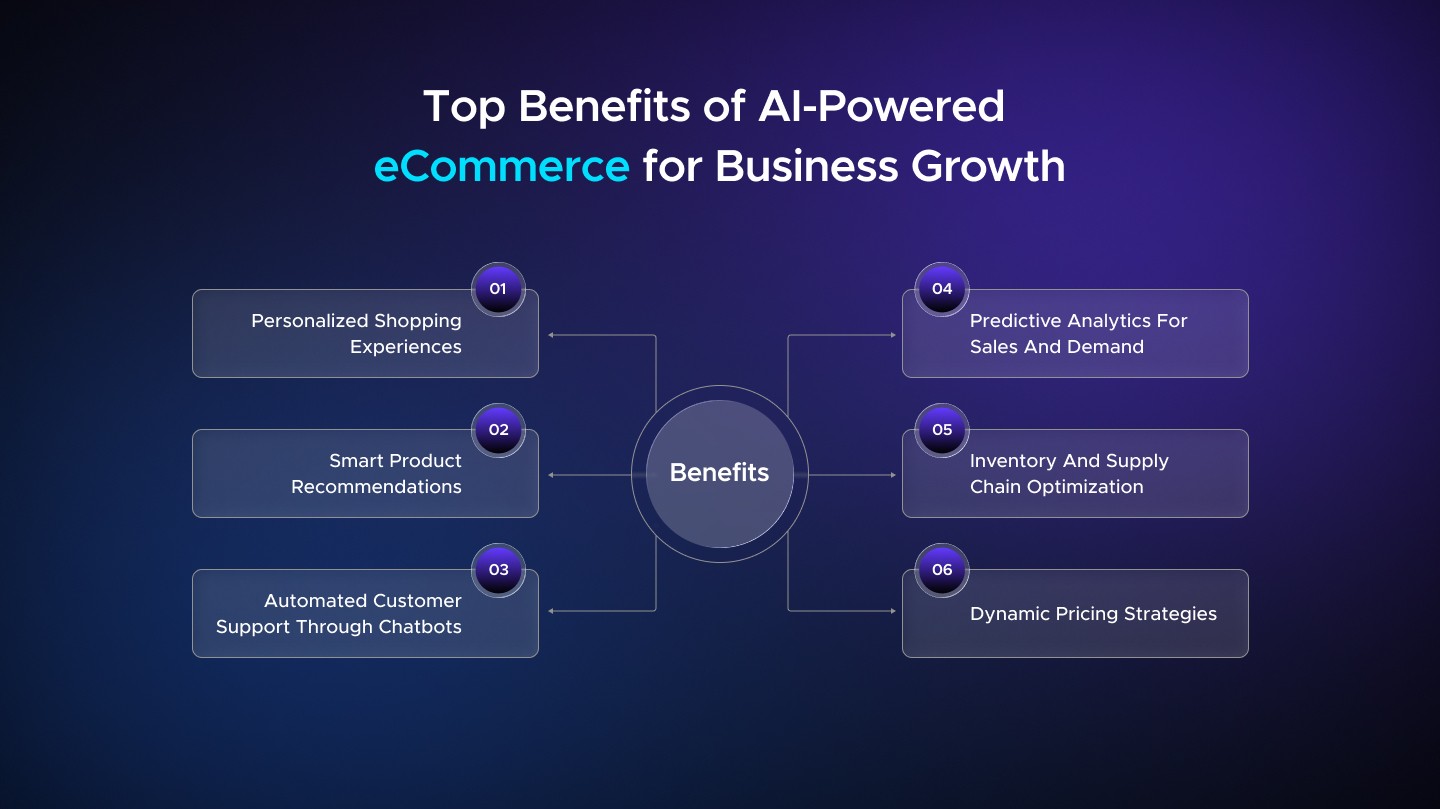
Personalized Shopping Experiences
Today's shoppers do not want to scroll through a generic list of products. AI studies what each user clicks on, what they skip, and what they add to their cart. It then adjusts the shopping experience based on that information. The right products appear at the right time, making the experience feel relevant to each visitor.Smart Product Recommendations
AI-powered recommendation tools suggest products that a shopper is likely to buy. Instead of showing the same popular items to everyone, they match products to individual users based on their browsing and purchase history. This increases the chances of a sale and raises the average order value.Automated Customer Support Through Chatbots
AI chatbots handle common customer questions without any human involvement. They respond to queries about orders, returns, and product details at any time. During busy periods like holiday sales, they manage high volumes of conversations without delays.Predictive Analytics for Sales and Demand
AI tools can forecast how much demand a product will see in the coming weeks. They look at past sales, seasonal patterns, and market changes to build accurate predictions. This helps businesses prepare stock levels, plan promotions, and allocate staff more effectively.Inventory and Supply Chain Optimization
Holding too much stock wastes money. Running out of stock loses sales. AI monitors inventory levels and demand patterns continuously. When stock drops below a set level, it can trigger a reorder automatically, keeping operations running smoothly.Dynamic Pricing Strategies
Fixed prices are not always the best approach. AI tools track competitor pricing, stock availability, and customer demand in real time. They adjust prices accordingly to improve sales and protect profit margins
Core Features of AI eCommerce Solutions
Below are the core features that well-built AI ecommerce solutions typically include.
AI Recommendation Engines
An AI-based recommendation engine for ecommerce matches products to shoppers based on their past behavior and preferences. These engines flag sections like "You May Also Like" or "Customers Also Bought."
Some clear AI personalization in ecommerce examples include Amazon suggesting products based on recent searches, or a fashion store showing outfits based on items a customer previously viewed. Good recommendation engines update as a customer continues browsing, keeping suggestions relevant throughout the session.Voice Search and Visual Search
More shoppers are using voice to search for products. AI-powered voice search understands natural, spoken queries rather than just typed keywords. Visual search lets customers upload a photo of a product and find similar items in the store. Both features make product discovery faster and easier.AI Chatbots and Virtual Assistants
Modern AI assistants do more than answer basic questions. They can hold longer conversations, remember context from earlier in the chat, and hand it over to a human agent when a query becomes too complex. Some can also suggest products based on what the customer is asking about.Fraud Detection Systems
AI tools monitor transactions and look for unusual activity. They check things like purchase location, order size, and payment details. If something looks suspicious, the system flags or blocks the transaction within seconds. This protects both the business and its customers.Customer Behavior Tracking
AI-powered analytics tools study how visitors interact with a website. They track which pages customers visit, how long they stay, and where they leave. This information helps businesses improve their site and make the shopping journey easier for customers.
How AI Improves eCommerce Business Growth
Higher conversion rates are one of the first results businesses notice. When product pages are personalized and search results are accurate, customers find what they want faster. That leads to more completed purchases.
Better customer retention comes from giving customers consistent and relevant experience. When shoppers feel that a store understands their preferences, they come back. Targeted follow-up emails and personalized offers help keep customers engaged over time.
Reduced operational costs follow automation. Ecommerce automation using AI tools reduces the need for large support teams and manual processes. Automated stock management cuts down on waste. AI tools that write product descriptions save content teams hours of work each week.
Data-driven decisions replace guesswork. AI surfaces clear insights from sales figures, customer feedback, and browsing trends. Managers can act on real information rather than assumptions, which leads to better outcomes across the business
Real-World Use Cases of AI in eCommerce
Personalized product suggestions are visible on almost every major retail platform today. When a store recommends products that match a customer's taste, that customer is more likely to buy. This is one of the most direct ways AI increases revenues.
Smart search functionality understands what a customer is actually looking for, not just the words they typed. A search for a "lightweight jacket for rainy weather" returns practical results, not a random list of jackets.
Automated email marketing uses AI to decide what to send, to whom, and when. Instead of sending the same email to every subscriber, each person receives content that matches their interests and purchase history.
AI-driven upselling and cross-selling show customers products that go well with what they are already buying. A customer purchasing a camera might be shown a suitable case or memory card at checkout. This raises the total order value without feeling forced.
AI Tools and Technologies Used in eCommerce Development
Machine Learning
Machine Learning forms the base of most AI applications in eCommerce. It involves training software on large sets of data so it can make accurate predictions. This is what powers recommendation engines and demand forecasting tools.Natural Language Processing (NLP)
Natural Language Processing (NLP) allows computers to understand and respond to human language. It is the technology behind chatbots, voice search, and review analysis tools. NLP helps systems read customer messages and respond in a way that makes sense.Computer Vision
Computer Vision lets computers interpret images. In eCommerce, this enables visual search, automatic product tagging, and virtual try-on tools. A customer can upload a photo of a product they like and find something similar in the store.Predictive Analytics
Predictive Analytics uses historical data to make forecasts about the future. It helps businesses anticipate which products will sell well, which customers are likely to stop buying, and which marketing efforts are worth the investment.
Challenges of AI in eCommerce Development
High implementation cost is a concern for many businesses, especially smaller ones. Building and maintaining AI tools requires investment in technology, data infrastructure, and specialist expertise. Initial costs can be significant.
Data privacy concerns are growing. Customers are more aware of how their personal data is collected and used. Regulations like GDPR set clear rules on data handling. Any AI system that uses customer data must be built with those rules in mind from the start.
Integration complexity is another challenge. Adding AI tools to an existing platform is not always straightforward. Older systems may not be built to work alongside newer AI technology and connecting them takes careful planning and skilled technical work.
Finding skilled developers is difficult. Building effective AI for eCommerce requires people who understand both ecommerce web development and retail business needs. That combination is not always easy to find, and demand for these professionals is high
Future Trends of AI in Online Shopping
The future of AI in online shopping points toward experiences that are far more intelligent and personalized than what most stores offer today.
Deeper personalization is on the way. AI will go beyond product recommendations. It will adjust pricing, page content, and site layout for each individual visitor based on their behavior and preferences in real time.
Voice commerce will keep growing. As more people use smart speakers and voice assistants in their daily lives, completing a purchase through voice will become a routine part of shopping.
AI-powered supply chains will become more common. Inventory systems will reorder stock before it runs and adjust delivery routes based on live data. This will lower costs and improve delivery reliability.
Autonomous shopping is becoming a reality. AI tools will be able to make repeat purchases on a customer's behalf, based on preferences they have already set. Subscription-based reordering is an early version of what this could look like.
Why Choose AI-Powered eCommerce Development Solutions
Choosing the right ecommerce development solutions from the start makes a significant difference. Custom ecommerce development allows businesses to build AI tools that fit their specific processes, product range, and customer base, rather than settling for a generic platform. A well-built recommendation or customer analysis tool takes time to develop and train.
AI systems also scale well. A tool built for a small product range and a modest number of customers can handle much larger volumes as the business grows, without needing to be rebuilt from the ground up.
The customer experience improves noticeably with AI in place. Faster search, relevant product suggestions, quick support responses, and smooth checkout all contribute to an experience that customers prefer and return to.
Business growth follows naturally. When more visitors convert into buyers, when customers return more often, and when operations cost less to run, the business is in a stronger position to grow
Conclusion
AI has moved from a future possibility to a present reality in eCommerce. It shapes how customers find products, how businesses manage their operations, and how decisions are made across the entire retail process.
Businesses that have adopted AI-powered development are already seeing results in sales, customer satisfaction, and efficiency. Those that have not are at a growing disadvantage.
However, turning AI into real business impact requires more than just tools. It demands the right technology and expertise to scale effectively.
Whether you are building a new store or improving an existing one, ecommerce software development powered by AI deserves serious consideration. The technology is available, the results are proven, and the businesses acting today are the ones that will lead tomorrow
Scale Your eCommerce Growth with Digital Factory 24
Looking to turn AI into real business results? Digital Factory 24 helps businesses build, scale, and optimize modern eCommerce ecosystems powered by AI.
✔ ecommerce development services to create high-performing, AI-powered online stores
✔ Data-driven digital marketing services to boost traffic, conversions, and ROI
✔ Scalable Global Capability Center (GCC) solutions to support long-term growth
✔ Drupal development services for secure, scalable, and enterprise-ready digital experiences
Start building your AI-powered eCommerce future with Digital Factory 24